
Thriving at the Intersection of AI and The Future of Work
We are sitting squarely at the nexus of three societal shifts in how businesses deliver growth: the demand for efficiency, the modernization of legacy businesses, and the evolution of the modern workforce. Without a doubt, software will be at the center of these groundbreaking transformations.
In parallel, companies like Meta, Amazon, Google, and Twitter are reinventing their approach to growth with leaner and hybrid workforces and a renewed focus on efficiency. The recent passing of Prop 22 in California is a sign of the modern employer-employee relationship.
If that wasn’t exciting enough, we are witnessing the meteoric rise of Generative AI – the latest manifestation of combining Artificial Intelligence (AI), Machine Learning (ML), and Big Data. It reminds us of post-2008 when we sat at the forefront of the creation of algorithmic newsfeeds that reinvented contention consumption at Facebook, and when we were building Quattro Wireless just as the first Apple was launching iPhone and the App Store.
We’re so excited to be in the front seat again for this next chapter. For the past four years, Oceans has been investing in how AI, ML, and Big Data are applied to the future of work with long-term goals – not short-term gains – in mind. While many feel paralyzed and are over-investing in the next shiny object, we will lead with confidence. We built Oceans for these exact moments. As the great Warren Buffet would say, now is the time to be greedy.

To drive this home, we wanted to break down our four main investment pillars, their relationships with AI, ML, and Big Data, and how they’ll revolutionize how we work in the next two decades:
1) Managing the Cloud Explosion
2) Rethinking and Re-Architecting Legacy Systems
3) No-Code/Low-Code Internal Tools
4) Enabling the Modern Workforce
We'll dive into each of these pillars below!
1. Managing the Cloud Explosion
Innovations in cloud infrastructure allow companies to store and analyze large amounts of data in a scalable and cost-effective manner. The next chapter? Learning how to manage the cloud using infrastructure and software that is accessible to organizations beyond data science teams.
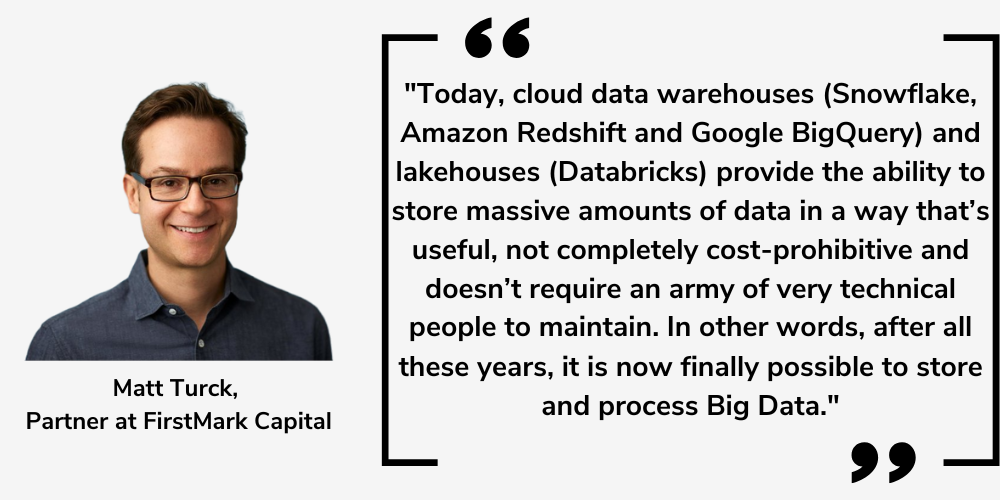
Every industry in the past decade has moved most – if not all – of its data to the cloud thanks to AWS, GCP, Snowflake, and Azure. As the amount of data being stored and analyzed grows, the reliance on cloud infrastructure continues to strengthen. According to new research, just in Q4 of this year, global enterprise spending on cloud infrastructure exceeded $61B. We expect the growth to continue, given the cloud's consistent expansion over the past two years (the 2022 cloud market grew by $47B from the previous year and by $49B in 2021).
2. Rethinking and Re-Architecting Legacy Systems
Legacy industries are aging (remember the Southwest Airlines debacle?) and there is an unparalleled need for new technologies to prevent those industries from becoming obsolete. We believe that in order to drive innovation forward, we need to rethink and re-architect the platforms and tooling that will deliver business process improvements and optimization – and many are already moving in that direction. Per a recent study:
- Over 70% of global company executives consider mainframe or legacy modernization a strategic priority for the next three years.
- 48% of digitally mature businesses are already modernizing mainframe or legacy applications while 47% more are planning on doing so.
Companies that embrace modern software solutions will streamline their operations, reduce costs, and gain a competitive advantage in their respective markets.
3. No Code, Low Code, and Internal Tools
It’s time to democratize the software development process – not just as a nice-to-have, but as a must-have. Simply put, the modern work environment will never be able to source or hire enough engineers: the IDC estimates a 4 million full-time developer shortage by 2025 while KornFerry forecasts $449.7B of unrealized output by 2030 due to high-skill labor shortages. These labor shortages are already leading to significant demand for low-code/no-code platforms (spearheaded today by generative AI) that enable users who are less technically proficient to contribute to the development process.
4. Enabling the Modern Workforce
A new workforce centered around the gig economy and hybrid work is driving the need for technology and systems that empower the modern workforce. Employers must invest in new tools, regardless of their location or device. We are investing in entrepreneurs building an entirely new software stack to drive this transformation forward.
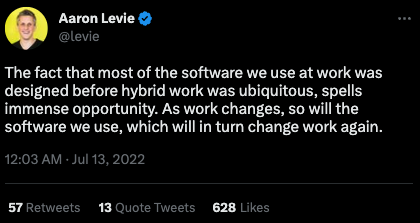
The explosion of the gig economy is real: today, the US is home to 59 million independent workers (~36% of the workforce) – with that number projected to grow to 86.5 million by 2027 (>50% of the workforce). When it comes to hybrid work, a McKinsey study found 58% of job holders (92 million people) say they can work remotely at least part of the time and 87% of them take up the offer. These trends are the tent poles for the modern workforce. It’s on us to drive its innovation forward.
It’s Time to Go Bold
As the world of work continues to undergo rapid change, tens of thousands of laid-off tech workers will now work for or start the next great company. New technologies and start-ups (see the Oceans portfolio) are opening up never-before-seen channels. The need to lead with compassion yet unapologetic prioritization amidst wars and politics is more important than ever. As investors, we’re excited to partner with the founders who are changing the world as we know it. It’s an exciting time – and one we will navigate with the diligence, prudence, and speed our founders and LPs expect of us.
Subscribe to get updates from our founders and things we’re thinking about.